
Everything you need to know about Apple's Mixed Reality Headset | Vision Pro
Alongside, Apple unveiled the operating system for the glasses, which is visionOS, which features a 3D user interface and is controlled without the use of any external controllers, which distinguishes it from any XR glasses on the market today. Vision Pro contains a huge package of complex technologies that help the user to immerse themselves in the virtual world, without completely disconnecting from the real world! So if you are interested, here is a look at the most important details about the Vision Pro glasses from Apple.
Let's start with the design, which is the most important and complex part of the Vision Pro. As reported at the conference, the entire front of the glasses is made from a single piece of curved glass that maintains the creation of an optical surface behind which hides the wide array of cameras and sensors needed to blend the real world with digital content. As for the frame or structure, it is made of carbon fiber and lightweight aluminum and comes in a range of shapes and sizes to accommodate the largest possible number of people, and the part that adheres to the user's face is lined in a streamlined and very flexible manner so that it conforms smoothly to the face for an accurate fit.

The top of the glasses contains a rotating button - similar to the Digital Crown button in the Apple Watch - which allows users to switch between augmented reality and virtual reality, so when the user is in virtual reality, he will be completely immersed with the content due to the high resolution, and when switching to augmented reality, the content fades A few applications and the glasses begin to blend with the real surroundings. Vision Pro glasses depend on an external battery to achieve a light weight and slim design, as the battery is attached via a magnetic connection to the side of the headset, while the battery can be placed in your pocket for easy transportation.
The other side of the glasses mask is an elastic bracelet that makes it securely attached to the head, as well as providing multiple sizes of headband to provide comfort and ventilation when wearing the glasses for hours. Apple has integrated the audio system for the glasses with this bracelet, so that the headphones remain close to the user's ears.

As for the technical specifications, the lenses in the Vision Pro glasses include two micro-OLED screens with a resolution of 4K each, to provide a high-resolution display system with 23 million pixels, which gives the user exceptional accuracy in displaying the content in front of him. The glasses also include many high-resolution external cameras to record what is happening with great accuracy, in addition to a ring of LED lights that displays invisible light patterns on the user’s eyes to track eye movement.

The Vision Pro also features an M2 chip paired with an all-new "R1" chip that is dedicated to processing signals sent by the glasses' sensors, including the 12 cameras, five sensors, and six microphones to ensure that content appears to be appearing right in front of the user's eyes, in real time. Thus this chip plays the role of eliminating the possibility of any delay in response. According to Apple, the R1 processor broadcasts new frames to screens every 12 milliseconds, which is 8 times faster than the blink of an eye! And about the battery life, Apple says that the Vision Pro can be used around the clock without interruption as long as it is directly connected to electricity, but when connected to the external battery, expect it to work for up to two hours.

The glasses also have a new spatial sound system with two amplifiers distributed over both ears to ensure an immersive audio experience that creates the feeling that the sounds come from the environment around the user and matches the sound with the space. Each audio pod (inside the headband) contains an amplifier designed to match the audio experience the user wants, similar to the experience offered by the latest AirPods.

In terms of features, the most important control method is the biggest advantage of the Vision Pro glasses so that the user does not need additional control units that he puts in his hands, but rather everything is done through hand gestures, eye movement and sound! As we mentioned, the glasses will rely on cameras, microphones, and multiple sensors built into the front structure to track every movement the user makes, so he can interact with applications and browse them by looking at them, clicking their fingers to select, moving their wrist to scroll, or using voice to dictate. In addition, the glasses display a virtual keyboard in which texts can be typed within applications as if you were using a real Magic Keyboard from Apple.
The glasses also offer an exceptional innovation that helps users stay in touch with those around them in a very distinctive way that Apple calls “EyeSight” so that when someone approaches the user while wearing Vision Pro, the glasses will enter transparency mode so that the user can see the other side, and the user’s eyes will also be exposed to people Additionally, when the user is immersed in an environment or using an app within the virtual world, EyeSight will give visual cues to others about what the user is focusing on.
And thanks to the multiple cameras built into the glasses, Vision Pro will easily allow the surrounding environment to be transformed into a movie theater, where video clips and movies are shown in a huge panoramic manner, which can completely surround the angle of view. The glasses offer a technology called Environments, which allows the user to replace the real surrounding environment with dynamic landscapes that interact professionally with the dimensions of the room, which may help him focus or reduce clutter in crowded places, and the extent covered by these scenes is controlled via the Digital Crown rotating button located upstairs.

Users can make video calls via the FaceTime application directly through the Vision Pro glasses, but in a completely different way, as the graphical interface merges with the environment surrounding the user to reflect each person in the call within templates that create a realistic feeling that people are speaking in front of you, in addition to the spatial sound that enhances the experience. It makes it as if the participants are speaking directly from where they are based on their position. But since the Vision Pro glasses do not contain a front camera that reflects your face to others, Apple has used a new technology that creates an alternative digital face for the user’s face to replace it in video calls. precisely on the contours and details of your face and then create an exact replica using Apple's advanced machine learning techniques.
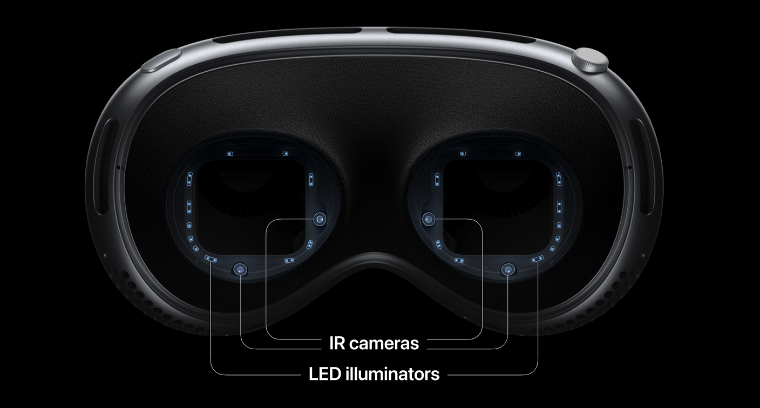
As for the authentication technology, Apple has revealed the Optic ID system, which replaces Face ID in the Vision Pro glasses, for identity authentication via the built-in iris scanner. A 3D camera is used to analyze the user's iris and compare it to the registered Optic ID data protected by the Secure Enclave chip to instantly unlock and unlock Vision Pro.
In terms of privacy, Apple has confirmed that eye-tracking information is shared, stored on company servers, or allowed apps or websites to access. Additionally, data from the camera and other sensors is processed locally, so apps don't need to see the user's surroundings to enable spatial experiences.

Finally, visionOS provides the glasses with an expansive dashboard for viewing applications and a 3D user interface. The system offers a completely new environment for developers to create applications that interact with the real world or allow digital tasks to be performed within the virtual world. Apple also announced that the iPhone and iPad applications will work without problems in the VisionOS system, so that you do not lose your favorite applications while wearing the glasses. The system includes a new app store, built from scratch, to discover apps designed for VisionOS as well as compatible iPhone and iPad apps.

Finally, for the price, the Apple Vision Pro costs $3,499 which is significantly higher than the prices of competitors such as the Meta Quest Pro and HTC Vive XR Elite. In any case, the glasses will not be available for purchase this year, as they will be available sometime during the first quarter of next year, but only in the United States of America, with the global rollout coming later in the same year.

As for the technical specifications, the lenses in the Vision Pro glasses include two micro-OLED screens with a resolution of 4K each, to provide a high-resolution display system with 23 million pixels, which gives the user exceptional accuracy in displaying the content in front of him. The glasses also include many high-resolution external cameras to record what is happening with great accuracy, in addition to a ring of LED lights that displays invisible light patterns on the user’s eyes to track eye movement.

The Vision Pro also features an M2 chip paired with an all-new "R1" chip that is dedicated to processing signals sent by the glasses' sensors, including the 12 cameras, five sensors, and six microphones to ensure that content appears to be appearing right in front of the user's eyes, in real time. Thus this chip plays the role of eliminating the possibility of any delay in response. According to Apple, the R1 processor broadcasts new frames to screens every 12 milliseconds, which is 8 times faster than the blink of an eye! And about the battery life, Apple says that the Vision Pro can be used around the clock without interruption as long as it is directly connected to electricity, but when connected to the external battery, expect it to work for up to two hours.

The glasses also have a new spatial sound system with two amplifiers distributed over both ears to ensure an immersive audio experience that creates the feeling that the sounds come from the environment around the user and matches the sound with the space. Each audio pod (inside the headband) contains an amplifier designed to match the audio experience the user wants, similar to the experience offered by the latest AirPods.

In terms of features, the most important control method is the biggest advantage of the Vision Pro glasses so that the user does not need additional control units that he puts in his hands, but rather everything is done through hand gestures, eye movement and sound! As we mentioned, the glasses will rely on cameras, microphones, and multiple sensors built into the front structure to track every movement the user makes, so he can interact with applications and browse them by looking at them, clicking their fingers to select, moving their wrist to scroll, or using voice to dictate. In addition, the glasses display a virtual keyboard in which texts can be typed within applications as if you were using a real Magic Keyboard from Apple.
The glasses also offer an exceptional innovation that helps users stay in touch with those around them in a very distinctive way that Apple calls “EyeSight” so that when someone approaches the user while wearing Vision Pro, the glasses will enter transparency mode so that the user can see the other side, and the user’s eyes will also be exposed to people Additionally, when the user is immersed in an environment or using an app within the virtual world, EyeSight will give visual cues to others about what the user is focusing on.
And thanks to the multiple cameras built into the glasses, Vision Pro will easily allow the surrounding environment to be transformed into a movie theater, where video clips and movies are shown in a huge panoramic manner, which can completely surround the angle of view. The glasses offer a technology called Environments, which allows the user to replace the real surrounding environment with dynamic landscapes that interact professionally with the dimensions of the room, which may help him focus or reduce clutter in crowded places, and the extent covered by these scenes is controlled via the Digital Crown rotating button located upstairs.

Users can make video calls via the FaceTime application directly through the Vision Pro glasses, but in a completely different way, as the graphical interface merges with the environment surrounding the user to reflect each person in the call within templates that create a realistic feeling that people are speaking in front of you, in addition to the spatial sound that enhances the experience. It makes it as if the participants are speaking directly from where they are based on their position. But since the Vision Pro glasses do not contain a front camera that reflects your face to others, Apple has used a new technology that creates an alternative digital face for the user’s face to replace it in video calls. precisely on the contours and details of your face and then create an exact replica using Apple's advanced machine learning techniques.

As for the authentication technology, Apple has revealed the Optic ID system, which replaces Face ID in the Vision Pro glasses, for identity authentication via the built-in iris scanner. A 3D camera is used to analyze the user's iris and compare it to the registered Optic ID data protected by the Secure Enclave chip to instantly unlock and unlock Vision Pro.
In terms of privacy, Apple has confirmed that eye-tracking information is shared, stored on company servers, or allowed apps or websites to access. Additionally, data from the camera and other sensors is processed locally, so apps don't need to see the user's surroundings to enable spatial experiences.

Finally, visionOS provides the glasses with an expansive dashboard for viewing applications and a 3D user interface. The system offers a completely new environment for developers to create applications that interact with the real world or allow digital tasks to be performed within the virtual world. Apple also announced that the iPhone and iPad applications will work without problems in the VisionOS system, so that you do not lose your favorite applications while wearing the glasses. The system includes a new app store, built from scratch, to discover apps designed for VisionOS as well as compatible iPhone and iPad apps.

Finally, for the price, the Apple Vision Pro costs $3,499 which is significantly higher than the prices of competitors such as the Meta Quest Pro and HTC Vive XR Elite. In any case, the glasses will not be available for purchase this year, as they will be available sometime during the first quarter of next year, but only in the United States of America, with the global rollout coming later in the same year.